
DRC: A message from Lumumba’s last son to the Congolese youth


A message from Guy Patrice Lumumba (Lumumba's last son) to the Congolese youth he asked Kambale Musavuli to share.
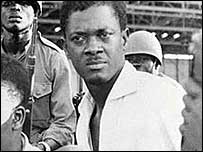
Patrice Lumumba

Patrice Lumumba

…when Lumumba wrote "To my children whom I leave and whom perhaps I will see no more…" He was speaking about us. He was reminding us of our inheritance which is the Congo.

He has requested that we read the last letter that his father wrote to his mother, Pauline. He said that in the letter, when Lumumba wrote "To my children whom I leave and whom perhaps I will see no more…" He was speaking about us. He was reminding us of our inheritance which is the Congo. His father gave all of us a mission when he said "I wish that they be told that the future of the Congo is beautiful and that it expects for each Congolese, to accomplish the sacred task of reconstruction of our independence and our sovereignty."

Guy Patrice added that we should be very wary of what the Congolese government is doing to rewrite the history and legacy of his father. He said that he does not approve of the Congolese government naming a town in Congo after his father without any consultation. He says what the DRC govt did by naming a town LumumbaVille is an insult to his father and his family. Why?

1. LumumbaVille is located in Kasai… near Katakokombe. According to Guy Patrice, the town has no electricity, no running water, no hospital and about 200 people live around that area. To get to that town you must take a made-shift ferry.

2. Given Lumumba was not a tribalist and his strong-hold was Kisangani in the Northeast of Congo, and that he also ran on a platform of national unity and won, Guy Patrice is wondering why they had to go choose a town in Kasai, pretty much limiting Lumumba to his tribal area though he was a nationalist. He would have preferred that Kisangani be chosen as Lumumbaville or even Lubumbashi near where they killed his father. He believes it is better to have a prominent city rather than a city where no one will go… all the way inside the country. It is like doing a Martin Luther King memorial in Idaho rather than in Atlanta.

3. If the DRC government really cared about Lumumba, they could sue the Belgians and Americans who participated in the killing of Lumumba. Lumumba's family has already started the lawsuit in Belgium. The DRC government could do the same to show their good intentions in honoring Lumumba's legacy.

Last message from Guy Patrice Lumumba is that it has been 53 years we are supposedly independent yet we have not been able to be sovereign on our land. The youth of 1960 did their part. We must do our part now.

Comments

Popular posts from this blog

Le Troisième Mandat de Louise Mushikiwabo à l'OIF : Entre Précédent et Principe Démocratique.

Le Troisième Mandat de Louise Mushikiwabo à l'OIF : Entre Précédent et Principe Démocratique. L'Alternance à l'OIF : Pourquoi un Troisième Mandat Fragilise la Crédibilité de la Francophonie. Introduction Louise Mushikiwabo veut un troisième mandat à la tête de l'Organisation internationale de la Francophonie. Son annonce, faite bien avant l'émergence d'autres candidats, rappelle une tactique familière en Afrique : affirmer qu'on a le soutien populaire sans jamais le prouver publiquement. La méthode est rodée. Des dirigeants africains l'utilisent depuis des décennies pour prolonger leur règne. Ils clament que "le peuple le demande" ou que "les partenaires soutiennent" cette reconduction. Aucune preuve formelle n'est nécessaire. L'affirmation devient réalité politique. Mais voilà le problème : la Francophonie prêche la démocratie, l'État de droit et l'alternance au pouvoir. Peut-elle tolérer en son sein ce qu...

Pourquoi les sanctions américaines contre le Rwanda sont-elles si importantes ?

Pourquoi les sanctions américaines contre le Rwanda sont-elles si importantes ? Auteur : The African Rights Campaign. Londres, Royaume-Uni Publié en : mars 2026   Introduction Lorsqu'un gouvernement est accusé d'exécutions extrajudiciaires, de déplacements massifs, de violences sexuelles, de violations des droits de l'homme et du pillage systématique des ressources naturelles d'un pays voisin, la réponse diplomatique attendue est un démenti catégorique, étayé par des preuves. Le Rwanda ne l'a pas fait. Lorsque le département américain du Trésor a imposé des sanctions aux Forces de défense rwandaises (FDR) et à quatre de leurs commandants les plus haut placés, le 2 mars 2026, la porte-parole officielle de Kigali, Yolande Makolo, a délivré une déclaration que les analystes diplomatiques étudieront attentivement pour ce qu'elle omet conspicuement. Elle a dit que les sanctions étaient « injustes », qu'elles ciblaient « uniquement...

Why US Sanctions Against Rwanda Are So Important

Why US Sanctions Against Rwanda Are So Important Author: The African Rights Campaign. London, UK Published: March 2026   Introduction When a government is accused of extrajudicial killings, mass displacement, sexual violence, human rights abuses, and the systematic pillage of another country's mineral resources, the expected response in international diplomacy is an unequivocal denial backed by evidence. Rwanda did not do that. When the United States Department of the Treasury imposed sanctions on the Rwanda Defence Force (RDF) and four of its most senior commanders on 2 March 2026, Kigali's official spokesperson Yolande Makolo made a statement that diplomatic analysts will study carefully for what it conspicuously omitted. She said the sanctions were 'unjust,' that they targeted 'only one party to the peace process,' and that they 'misrepresent the reality and distort the facts.' Rwanda's government, described by Bloomb...

BBC News

Africanews

UNDP - Africa Job Vacancies

How We Made It In Africa – Insight into business in Africa

Migration Policy Institute