
US Government to Push Direct Peace Talks Among African Governments and Their Moderate Armed Opposition?
US Government to Push Direct Peace Talks Among African Governments and Their Moderate Armed Opposition?
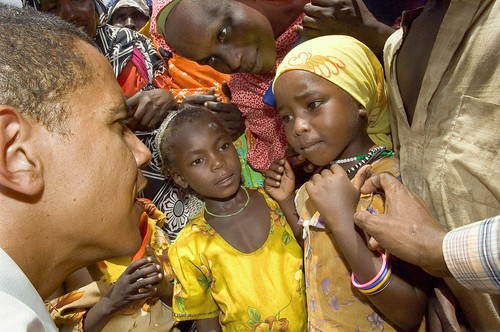
Photo: President Barack Obama Chatting with Kids in Africa in 2009.
His trip to Africa comes when there are significant political, diplomatic, and security developments in the Great Lakes Region of Africa:
- The Peace, Security and Cooperation (PSC) Framework for the DRC and the Region (see See our article: UN Special Envoy in Great Lakes: Will Rwandan President Kagame Seize the Opportunity of March 7, 2023)
- the appointment by the UN Secretary General Special Representative, the deployment of UN Intervention Brigade, and
- the recent statements by the Tanzanian President Jakaya Kikwete at the occasion of the 50th Anniversary of the African Union in which he urged the Heads of State of Rwanda, Uganda and the Democratic Republic of the Congo (DRC) to open direct talks with their armed opposition as the best way to bring durable peace in the eastern DRC and Rwanda (see our article: Talk to Your Armed Opposition, Tanzanian President Kikwete Tells Yoweri Museveni of Uganda, Paul Kagame of Rwanda, and Joseph Kabila of DRC of May 26, 2013)
But most importantly, it comes when there is worldwide and within US Government momentum to promote peace over wars, direct talks over bloodshed.
US Government is to Open Direct Peace Talks with the Taliban
This Tuesday, Senior Whitehouse officials have confirmed that the US Government will, this week starting this Thursday, hold direct talks with the Taliban, after more than 12 years of fighting. This is a major shift in the US policy regarding the Taliban. The meetings will be held in Doha, Qatar where the Taliban have already offices. The US government has put conditions that the Taliban must renounce violence first, respect the Afghan constitution, and break ties with al-Qaeda. Negotiations are expected to be intense and to test the nerves of both the US Government nnd the Taliban negotiators. In fact, in the past, Taliban have always criticized Afghan President Karzai of being the puppet of the West, whereas the Afghan President has criticized the US and Quatari governments of contacting the Taliban without his approval. The US Government's openness to direct talks is a major shift in the vision on how armed conflicts around need to be resolved and may signal the tone of the talks the US Government will have in South Africa and Tanzania.
President Obama will most likely support Tanzanian President Jikaya Kikwete's vision of direct talks as the best way to resolve conflicts.
US President Barack Obama will likely Support Tanzania President Jakaya Kikwete's recommendation to Rwandan President Paul Kagame, Ugandan President Yoweri Museveni and DRC President Joseph Kabila to hold talks with their respective armed opposition.
On May 26, 2013, Tanzanian President Jakaya Kikwete urged direct talks among belligerents in Rwanda, Eastern DRC, and Uganda. For him, the United Nations Intervention Brigade is helpful in the short term but is not paramount for durable peace in the Great Lakes region. To have durable peace, a global dialogue is warranted. General Paul Kagame needs to have direct talks with the Rwandan armed rebel movements operating from the Congolese provinces of Kivus the Democratic Republic of the Congo (DRC), especially the Democratic Liberation Forces of Rwanda (FDLR). Ugandan President Yoweri Museveni needs to hold similar talks with the rebels from the Allied Democratic Forces/National Army for the Liberation of Uganda [ADF-NALU] opposed to his government, and Democratic Republic of the Congo (DRC) President Joseph Kabila needs to jump start the peace talks with M23 Congolese rebels.
If the US is ready to talk to the Talibans, then General Paul Kagame of Rwanda can no longer have an excuse of not talking to the Rwandan armed opposition. The same for Yoweri Museveni of Uganda and Joseph Kabila of DRC.
Joseph Kabila is already talking to his armed opposition of M23 rebels. Yoweri Museveni has supported Jikaya Kikwete's proposal. The black sheep among the leaders of the region is General Paul Kagame who, along with his puppet Hutu Prime Minister Pierre Habumuremyi, and his blaring Minister of Foreign Affairs Ms Louise Mushikiwabo, chose to denigrate, slander and libel the Tanzanian President for proposing the direct peace talks.
President Obama's public support for direct talks among African belligerents will likely increase pressure on General Paul Kagame.
In South Africa, President Obama's visit comes at the heels of the SADC endorsement of direct talks in Rwanda , DRC, and Uganda. He will most likely echo SADC's call.
On Saturday June 15, 2013, the Extraordinary Summit of the Heads of State and Government of Southern African Development Community (SADC) held in Maputo, Mozambique, urged Rwanda and Uganda to consider direct talks with all armed opposition group for a long lasting political solution in the Great Lakes Region.
In their joint communique at the end of the Summit, the SADC leaders said: "The Summit noted that there is need for the Engagement among all political stakeholders in the DRC to find a long lasting solution to peace, security and stability:
In the same communique, the leaders applauded Ugandan President Yoweri Museveni for mediating in the peace talks between the DRC government and the M23 rebels.
With Yoweri Museveni applauded by SADC and Joseph Kabila acknowledged for his direct talks with M23 rebels, who remains isolated: General Paul Kagame. The endorsement of the direct talks by President Obama during his trip will further isolate General Paul Kagame.
©2013 AfroAmerica Network. All Rights Reserved.
Comments
Post a Comment