
http://therisingcontinent.wordpress.com/2013/01/12/paul-rusesabagina-another-tribunal-for-rwanda-needed/
Paul Rusesabagina: another tribunal for Rwanda needed
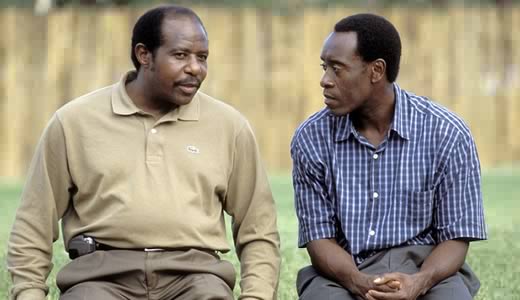
Paul Rusesabagina and Don Cheadle
In a long interview given to Daniel Kovalik and published on the Counterpunch website, Paul Rusesabagna, the Rwandan famously portrayed in the movie Hotel Rwanda by Don Cheadle, touches on a range of varied and critically important issues. He talks about 1) criminal charges against him from the Rwandan government, 2) Rwanda civil war and genocide from 1990 to 1994, 3) massacres of Kibeho of 8,500 Hutu internally displaced in 1995, 4) bigger number of Hutu than of Tutsi who died during the Rwandan war, 5)6 millions of Congolese dead further to wars of invasion by Rwanda and other countries including Uganda, 6) UN Mapping report published on October 1st, 2010, 7) rebel group M23, 8) the U.S. role, and 8) forced sterilization of Hutu men in Rwanda.
The following is only an extract where he highlights the importance of revisiting the justice which was provided to Rwandans through the International Tribunal Court for Rwanda.
DK: I read somewhere that you think there needs to be a new truth tribunal in Rwanda. And, why is this, what was wrong with the first international criminal tribunal on Rwanda? What were the shortcomings there?
PR: This is the problem. In 1990, the RPF, consisting mostly of Tutsis living in exile, invaded Rwanda from Uganda. So, when they invaded Rwanda, there was a civil war for 4 years. In that civil war, that army, those rebels, we called them rebels at that time, were killing each and every person, every Hutu on their way. People fled their homes. They were occupying slowly. And, by 1993, early 1994, before the genocide, we had about 1.2 million displaced people who were surrounding Kigali the capital city, having to bathe in town, going to sleep in the open air in camps, dying every day, hungry. So, in 1994, these rebels, who had already signed a peace accord with the government, killed the President. That is a fact which almost everyone knows. So, when they killed him, the genocide broke out. Now, we were in a civil war where civilians were being killed by both sides. The civil war never stopped. The genocide happened within a civil war. Both sides killed, and now, afterwards, in July 1994, when the period of the genocide ended, after 3 months, 90 days, the Tutsi rebels took power. They took power in blood from both sides. And, the international community gathered the United Nations, and they decided to put up a tribunal for Rwanda. That tribunal was supposed to try and convict Rwandans who killed Rwandans for a period of time from January 1 through December 31 of that year [1994]. From January 1 through December 31 of that year, I saw myself with my own eyes, this [RPF] army tying people with their hands behind their backs and beating their chests, breaking it, throwing them into containers, burning their bodies, and spraying their ashes into the national game preserve. I am a witness to this. But, because the Hutus lost the war, they are the only ones being tried and convicted. So, the international tribunal, the international criminal court for Rwanda, is a court for the losers. But, both have been killing civilians. They say that the Hutus committed the genocide, but the Tutsis also committed war crimes, crimes against humanity.
To read the full interview, please click here.
Comments
Post a Comment