
Invigorated by Recent Successes Against Rwandan Defense Forces, Rwandan Rebels Close in to Rwandan Border
Invigorated by Recent Successes Against Rwandan Defense Forces, Rwandan Rebels Close in to Rwandan Border
According to the June 20, 2013 leaked report by the United Nations Group of Experts on the Democratic Republic of the Congo (DRC), the rebels have been taking advantage of the chaos created by M23 Congolese rebels, supported and funded by Rwandan military and political leaders, to infiltrate Rwandan from the weakened and exposed western flank of the M23 positions. Some attacks were launched by 4 units known as "Commando de recherche et d'action en profondeur (CRAP)". One CRAP unit operates from Nyamulagira and 3 others known as Canaan, Sinai and Ruhinda. These four CRAP units belong to Rwandan rebels known as FDLR-FOCA.
Other Rwandan rebels have also been crossing into Rwanda and have launched several attacks since May 2013, killing several RDF troops and seizing weapons and equipments. These rebels include the Rally for Unity and Democracy (RUD-Urunana), Rally for the Rwandan People (RPR-Inkeragutabara), and the PS-Imberakuri's Common Front for the Liberation of Rwanda or Front Commun de Liberation du Rwanda (FCLR) (see here about PS_Imberakuri's rebels.
In deploying towards the Rwandan border, the rebels have split into several groups. According to the UN Experts's leaked report, "the FDLR suffers from internal divisions and a weak hierarchy that lacks the capability to command and control the organization's entire operations.The movement's leadership is divided between hardliners such as Mudacumura who want to continue the armed struggle, and moderates belonging to younger generations."
Hence, sources close to FDLR-FOCA have told that compensate for the lack of leadership the FDLR-FOCA have split into several autonomous parts, each lead by a commander most trusted by the younger generations. According to AfroAmerica Network's sources based in Eastern DRC, in South Kivu, the FDLR-FOCA operational troops are led by Colonel Jobs and Colonel Nicholas. In that area, more than 3,500 troops have deployed from other areas, especially from Bunyakiri, Walungu, and South Walikale and converged to Bihari, Kalehe, Bunyakiri, Kashehi, Kitumba-Ninja and Luyuyu (see our January 9, 2013 article here).
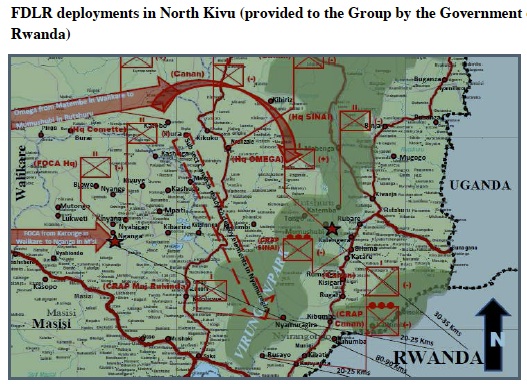
FDLR-FOCA Deployment Map. Source: UN GOE Leaked Report.
In North Kivu, most of the operational troops are under the overall command of General Omega, and is divided into three branches under the command of General Omega himself, Colonel Leopold Mujyambere aka Achille Musenyeri,FDLR new chief of Staff who replaced General Leodomir Mugaragu, assassinated by Rwandan Defense Forces special forces (see our article here) and Colonel Caleb aka Vedaste Hatangumuremyi. Colonel Kaleb got his name when he successfully led the 2000-mile-exodus of Rwandan Hutu refugees from Kamina in Katanga Province to Eastern DRC, in 2002-2003, following massacres of Hutu refugees and disarmed troops by a coalition of FARDC, then known as Forces Armees Congolaises (FAC), and international troops (see our January 31, 2003 article: FDLR members who survived Kamina massacres talk of their ordeal). During the exodus that took more than three months, no one among the 5,000 refugees, including hundreds of troops that had deserted the FARDC to join the exodus, died.
For now, it appears that the FDLR-FOCA overall commander General Mudacumura, wanted by the International Criminal Court, has lost command of his troops and remains confined in Walikale, in an area close to Bibwe and Nyange. According to our sources, the commanders do not even bother to inform him about the operations launched by FDLR-FOCA troops.
It is also in North-Kivu that two other important rebel groups are based: the mostly Hutu rebels of the Rally for Unity and Democracy (RUD-Urunana) allied with the mostly Tutsi rebels of Rally for the Rwandan People (RPR-Inkeragutabara). These two secretive groups also have their own independent organizations. Because of their secretive nature, AfroAmerica Network did not receive any reliable information on their organization and their command and control structure.
However, based on the sources in the area, it is these two groups that appear to have launchedthe latest two almost simultaneous attacks in late June 2013, one on June 23, 2013 and the other on June 24, 2013, killing 3 RDF troops and seizing wagons and communication equipments.
According to sources close to PSI-Imberakuri, FCLR leaders have mostly been focusing on recruiting fighters from within Rwanda and supplying recruits to the other three rebel groups.
The current situation is the the Rwandan rebels, now well armed with modern weapons and equipments seized on M23 rebels and RDF troop may launch even more deadly attacks inside Rwanda in days or months to come. Sources with Rwandan Defense Forces told AfroAmerica Network that following the May and June 2013 attacks, General Paul Kagame has ordered a general mobilization of the military and has sent RDF special forces to fight along the M23 Congolese rebels with two missions: making sure M23 rebels are not military defeated and preempting any infiltration of Rwandan rebels into the Rwandan territory. At the same time, General Paul Kagame has also ordered the deployment of thousands of troops along the Rwanda-DRC border, especially in the Virunga park.
©2013 AfroAmerica Network. All Rights Reserved.
Comments
Post a Comment