
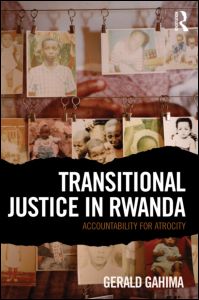
Transitional Justice in RwandaAccountability for AtrocityBy Gerald GahimaPublished December 19th 2012 by Routledge – 432 pages DescriptionTransitional Justice in Rwanda: Accountability for Atrocity comprehensively analyzes the full range of the transitional justice processes undertaken for the Rwandan genocide. Drawing on the author's extensive professional experience as the principal justice policy maker and the leading law enforcement officer in Rwanda from 1996-2003, the book provides an in-depth analysis of the social, political and legal challenges faced by Rwanda in the aftermath of the genocide and the aspirations and legacy of transitional justice. The book explores the role played by the accountability processes not just in pursuing accountability but also in shaping the reconstruction of Rwanda's institutions of democratic governance and political reconciliation. Central to this exploration will be the examination of whether or not transitional justice in Rwanda has contributed to a foundational rule of law reform process. While recognizing the necessity of pursuing accountability for mass atrocity, the book argues that a maximal approach to accountability for genocide may undermine the promotion of core objectives of transitional justice. Taking on one of the key questions facing practitioners and scholars of transitional justice today, the book suggests that the pursuit of mass accountability, particularly where socio-economic resources and legal capacity is limited, may destabilize the process of rule of law reform, endangering core human rights norms. Moreover, the book suggests that pursuing a strategy of mass accountability may undermine the process of democratic transition, particularly in a context where impunity for crimes committed by the victors of armed conflicts persists. Highlighting the ongoing democratic deficit in Rwanda and resulting political instability in the Great Lakes region, the book argues that the effectiveness of transitional justice ultimately hinges on the nature and success of political transition. Contents1. Theoretical Framework of Transitional Justice 2. A Decade of Atrocities 3. Accountability for Mass Atrocity: Challenges, Choices and Goals 3. National Prosecutions 4. Accountability, Justice and the Role of the International Criminal Tribunal for Rwanda 5. National Prosecutions 6. Seeking Alternative Accountability Mechanisms 7. Trials based on Universal Jurisdiction 8. Untold Story, Unfinished Business; Confronting the Crimes of the Victors 9. Assessing the Impact and legacy of Rwanda's processes of Accountability for Atrocity 10. Tentative Lessosns from Rwanda's mechanisms of Accountability for Atrocity 11. Conclusion Author BioGerald Gahima was central to the rebuilding of Rwanda's justice system in the aftermath of the 1994 genocide, first as the chief of staff to the Rwandan Minister of Justice from 1996-1999, and subsequently as the country's Attorney General from 1999-2003. He now works as an independent consultant to various organizations, including UN bodies, on issues relating to the rule of law and reconstruction of post conflict countries. Name: Transitional Justice in Rwanda: Accountability for Atrocity (Paperback) – Routledge |

C'était en novembre 2025, à Kigali. En marge de la 46e Conférence ministérielle de la Francophonie, Louise Mushikiwabo prenait la parole avec l'assurance de celle qui n'a rien à craindre : de nombreux pays, affirmait-elle, lui avaient demandé de se représenter. Spontanément. Naturellement. Unanimement presque. Sauf que les faits racontent une tout autre histoire. L'annonce qui ne devait pas avoir lieu si tôt Novembre 2025. Le Centre de Conventions de Kigali accueille plus de 400 délégués des 90 États membres de l'Organisation internationale de la Francophonie. Le thème officiel porte sur les femmes et l'égalité des genres, trente ans après Pékin. Mais en marge des séances plénières, c'est une autre affaire qui agite les couloirs : Louise Mushikiwabo vient d'annoncer qu'elle souhaite briguer un troisième mandat. L'annonce est prématurée. Délibérément. Les candidatures ne ferment qu'en avril 2026. Aucun autre pays n'a encore ...
Comments
Post a Comment