
KPFA Evening News Anchor David Rosenberg: Supporters of Rwandan political prisoner Victoire Ingabire will hold an all day sit-in outside the Rwandan Embassy in Brussels on Friday, Nov. 1, the day that Rwanda's Supreme Court is scheduled to rule on her appeal. Ingabire has been behind bars in Rwanda's 1930 maximum security prison for three years, since October of 2010.
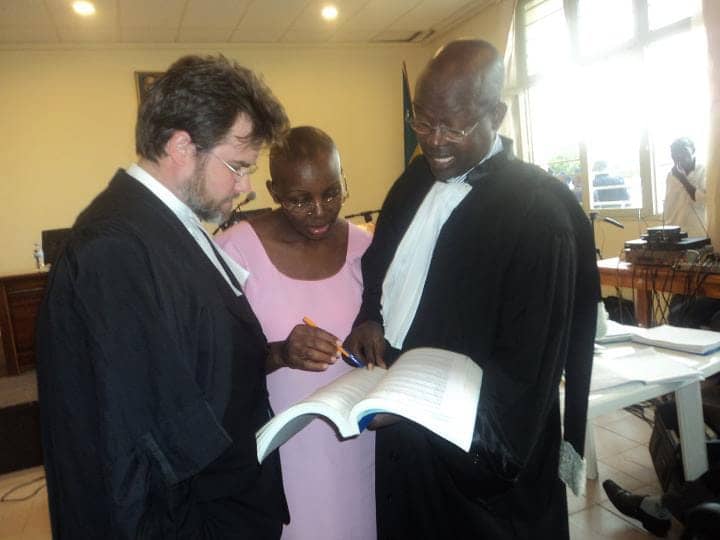
KPFA/Ann Garrison: Victoire Ingabire's supporters have announced that they will sit in outside the Rwandan Embassy in Brussels on Nov. 1, not only to denounce her political trial but also to demand human rights, political space and the release of all political prisoners in Rwanda. In May of this year, the European Parliament called on Rwanda's highest court to meet international judicial standards in its ruling on Ingabire's appeal.
The Rwandan Supreme Court is scheduled to rule approximately three weeks after the African Union passed a resolution demanding immunity from prosecution by the International Criminal Court – for sitting heads of state – for war crimes, crimes against humanity and genocide. East African heads of state, including Rwanda's Paul Kagame, introduced the resolution and argued most forcefully that crimes committed in Africa should be adjudicated in African courts.
Ingabire's British lawyer, Iain Edwards, has said that, if Ingabire's conviction is not overturned by the Rwandan Supreme Court, he and her Rwandan lawyer, Gatera Gashabana, will appeal further to a regional African court and then to the African Court on Human and People's Rights. But he also said that he will be flying out of London to Kigali on Thursday, with fingers and toes crossed. Here's some of what he told KPFA about his client during her trial:
Iain Edwards: She's been an absolute joy to represent. She is an extraordinarily courageous woman. She's an intelligent woman. She's a fiercely independent woman. She's a person that I've got on extremely well with. She's loyal and it's my very firm belief that what she wants is the very best for the Rwandan people. She makes absolutely no distinction whatsoever between Hutu, Tutsi, Twa. She sees the Rwandan people as simply that, the Rwandan people.
She wants peace in her country. She wants the population to live in harmony. Where there are differences, to embrace those differences and to live with those differences, but fundamentally to live in peace and harmony.
She wants there to be reconciliation in Rwanda, something which just does not exist in the way that the government likes to portray it as existing. And, in order to achieve that goal, she is prepared to act with complete selflessness. She knew that she ran a very, very high risk of being arrested and imprisoned when she traveled from the Netherlands to Rwanda in January of 2010.
She wants there to be reconciliation in Rwanda, something which just does not exist in the way that the government likes to portray it as existing. And, in order to achieve that goal, she is prepared to act with complete selflessness.
KPFA/Ann Garrison: Ingabire's case is of significance to the whole Great Lakes Region, but particularly to Rwanda's neighbor, the Democratic Republic of the Congo, which Rwanda and Uganda invaded in 1996 in the aftermath of the Rwandan Genocide. The undeclared cross border war between Rwanda's M23 militia and the Congolese army resumed this week, despite so-called peace talks in Kampala, Uganda. And it is often characterized as a conflict between Hutu and Tutsi. Others, however, including the U.N.'s Group of Experts investigators, have described the conflict's roots in foreign powers and corporations' claims to eastern Congo's vast oil and mineral wealth.
For Pacifica, KPFA and AfrobeatRadio, I'm Ann Garrison.
Oakland writer Ann Garrison writes for the San Francisco Bay View, Global Research, Colored Opinions, Black Star News and her own website, Ann Garrison, and produces for AfrobeatRadio on WBAI-NYC, KPFA Evening News and her own YouTube Channel, AnnieGetYourGang. She can be reached at ann@afrobeatradio.com. This story first appeared on her website. If you want to see Ann Garrison's independent reporting continue, please contribute on her website at anngarrison.com.

Comments
Post a Comment