
Rwandan government accused of abducting Paul Rusesabagina
Inspiration for Hotel Rwanda film paraded in Kigali after allegedly being taken from Dubai
Rwandan government accused of abducting Paul Rusesabagina
Rwandan government accused of abducting Paul Rusesabagina
Inspiration for Hotel Rwanda film paraded in Kigali after allegedly being taken from Dubai
Rwandan government accused of abducting Paul Rusesabagina
Inspiration for Hotel Rwanda film paraded in Kigali after allegedly being taken from Dubai
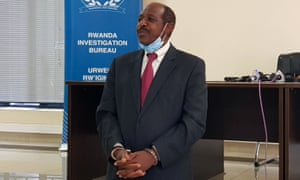
The family of Paul Rusesabagina, a businessman whose role in saving more than 1,000 lives inspired the film Hotel Rwanda, have accused the east African country's authorities of kidnapping the 66-year-old from Dubai.
On Monday, Rusesabagina, who is an outspoken critic of President Paul Kagame, was paraded in handcuffs by Rwandan investigators before media in the capital, Kigali, accused of terrorism-related crimes.
Rusesabagina was the general manager of a luxury hotel in Kigali during the 1994 genocide, in which an estimated 800,000 people were killed with knives, clubs and other weapons. The vast majority of the victims were from the Tutsi minority, though some Hutu moderates also died.
The 2004 film told the story of how Rusesabagina, a middle-class Hutu married to a Tutsi, used both his influence and bribe ry to save the lives of 1,200 people who sheltered at the Mille Collines hotel in the capital during the worst of the massacres.
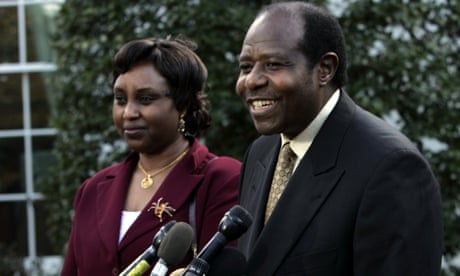
Rwand an authorities have said Rusesabagina was arrested on what they described as "an international warrant" and is accused of being "the founder, leader, sponsor and member of violent, armed, extremist terror outfits … operating out of various places in the region and abroad."
Rusesabagina's adopted daughter, Carine Kanimba, said she last spoke with him before he flew to Dubai last week but she did not know the exact nature of his trip.
Kanimba said his family was informed early on Monday that he was being held in Rwanda but they had not been able to speak to him.
"We're hoping to secure his release quickly and safely," she said. "What they're accusing him of is all made up. There is no evidence to what they're claiming. We know this is a wrongful arrest."
Another daughter, Anaise, told BBC World Service radio that her father had last called them on Thursday from Dubai.
"I believe he was kidnapped because he would never go to Rwanda of his own will," Anaise told the BBC.
Rusesabagina lives in Belgium and the US, where he was honoured by a Presidential Medal of Freedom, the nation's highest civilian honour, by the then president George W Bush in 2005.
He has been an increasingly outspoken critic of Kagame, and has been accused by Rwandan prosecutors of having links to rebel groups in the neighbouring Democratic Republic of the Congo which have been blamed by officials for cross-border attacks.
In 2010, Rusesabagina spoke out against the jailing of the opposition leader Victoire Ingabire Umuhoza, and four years ago he announced a political campaign against the government, which he called a dictatorship.
A statement from investigators described charges against him including terrorism, arson, kidnap and "murder perpetrated against unarmed, innocent Rwandan civilians on Rwandan territory". The details of his detention remain unclear.
Kagame maintains a close relationship with Dubai .
The government has previously been accused of hunting down dissidents overseas. South African investigators have said the government was directly involved in the killing of Patrick Karegeya, an outspoken critic, in Johannesburg in 2014.
Kagame said afterwards: "Any person still alive who may be plotting against Rwanda, whoever they are, will pay the price."
Rusesabagina has previously denied the government's claims that he funds Rwandan rebels, and has urged western countries to press the government to respect human rights.
Kagame is largely credited with the development and stability Rwanda has experienced since the genocide, but he is also accused of extreme authoritarianism .
In 2017, Kagame won a landslide victory in a presidential election, securing a third term in office with almost 99% of votes cast.
The Rwandan government disputes Rusesabagina's story about saving people during the genocide, and Ibuka, a Rwandan genocide survivors' group, has in the past said Rusesabagina, who runs a humanitarian foundation, exaggerated his own role in helping people escape the genocide.
Katrina Lantos Swett, the president of the Lantos Foundation for Human Rights and Justice, said: "I believe it is a travesty that a human rights champion like Paul Rusesabagina should be captured, detained and held in the way he is being held. This should raise a lot of deep concern and scepticism on behalf of a lot of people."
|

Comments
Post a Comment