
Matt Forest calls Paul Kagame a big liar

http://therisingcontinent.wordpress.com/2013/01/29/matt-forest-calls-paul-kagame-a-big-liar/#more-3579

Matt Forest calls Paul Kagame a big liar
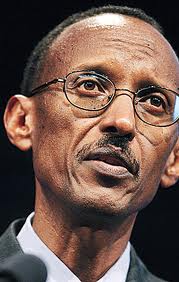
Rwandan president Paul Kagame - Time picture
Rwandan president Paul Kagame – Time picture
I am reproducing here a comment that Mark Forest wrote after reading and watching CNN presenter Christine Amanpour's interview of Paul Kagame.One of the focuses of the exchange between the journalist and the Rwandan president is when he intends to step down.
This first sentence that seems to guide Western countries policies toward Rwanda is already false:
"Rwanda's president, Paul Kagame, has been a darling of the West ever since he led his country out of the terrible 1994 genocide that left up to one million people dead."
At the scene of a CRIME, any crime, when looking for the criminal, there are always few questions:
(1) the beneficial of the crime;
(2) the modus operandi or how the criminal operates;
(3) who are the potential victims and so on…
First, Kagame and colleagues from Tutsi minority (10% of the population) [according to the last known official statistics they were 14% in the early 1990s] wanted absolute power over Hutu majority. Without a full controlled chaos, there was no power to them.
Second, if you look carefully on how criminals operated, you will find one single trend taking you to authors of the genocide. Through the UN "Mapping Report", there is no doubt, Rwandan army under Tutsi minority committed a genocide in DRC. Then, if you look at how the massacres were done in DRC, you compare the killings to those done early in Uganda just before Museveni came to power in 1986, you will see a common actor.
Finally, if you see similarities in these killings, you compare them to those which happened in Rwanda, you will find that Kagame and his men are mostly responsible for crimes committed in the Great Lake Region of Africa from 1980ies to now.
But, some western leaders such as Bill Clinton, Tony Blair and the UN share the responsibility. The international system tends to cover these Big Fishes and the smaller benefit from the whole situation.
Yes, Kagame is a big liar, but the international system covers his actions.
To read the full interview of Paul Kagame and other comments please click here

2 RESPONSES TO MATT FOREST CALLS PAUL KAGAME A BIG LIAR

  1. I do not know who Matt Forest is but his revision of Rwanda's history reflects someone either sympathetic to Hutu supremacists who are responsible for the 1994 genocide against the Tutsi or else misinformed all together. First of all, the notion that the Tutsi are a minority and so should not rule the Hutu majority is misleading. President Kagame's political base is not based on ethnicity, its based on a popular nationalist political party called the "Rwanda Patriotic Front" RPF, whose membership cuts across ethnicity, region, religion and other labels Matt Forest may want to create. Secondly, ethnic divisions in Rwanda are not natural; they are a construction of the colonialists. Thirdly, the 1994 genocide against the Tutsi is well documented horror, officially recognised for what it is by the UN. Those other "genocides" that Matt Forest claims happened in the DRC and Uganda are just conctions.
    • I find strongly incorrect what you are saying. Me neither I don't know who you are as a person or Matt Forest but his argument is straightforward. Why would someone deliberately avoid looking into who a crime benefits, the way of operating of the criminal and the real victims, if they are not hiding something fishy? It's true the Rwandan Patriotic Front and its leadership have used many tricks to hide their evident responsibilities in the monstrous crimes committed in the region, and questioning their role should be seen as overdue rather than being considered as a revision of history. It is the only logical way to do justice for the millions of their victims. As for the question of Tutsi being a minority, this is an undeniable fact. It would be like denying that white South Africans are not a minority in their country. The problem arises only when that minority once in power wants to exclude anybody else and oppress them. The issue is not Tutsi leading Rwanda, but their lack of fairness in that role, which so far in recent and past historic examples seem to show quite difficult for them to share fairly the wealth of Rwanda. RPF as an national political party, I will only concede its exclusiveness in accumulating all the wealth of the country and sharing it among its elite or blackmailing anybody not willing to join it. About ethnicity, when you indicate that there are no natural divisions in Rwanda and at the same time there exist an official narrative saying that the Rwandan genocide was against Tutsi, it would be interesting to clarify for foreigners how you accommodate those two notions in their mind. Who were those Tutsi killed in 1994? How different or similar to the rest of other Rwandans? Was it ethnically or otherwise? Unless you could provide sufficient clarifications on these questions, your assertion on the inexistence of natural ethnic divisions in Rwanda is totally flawed. It's not enough to blame colonialists when we the descendents of the victims of those divisions are still around. I understand where you are coming from when you treat other genocides committed by RPF people in the Great Lakes region as noted by Matt Forest as conctions. There cannot be any other genocide except the one against Tutsi because they are the only ones worth one to be acknowledged by the UN. The 8 millions of Congolese and others of Rwandans and Ugandans are not worthless. Isn't this a supremacist argument you are advancing here which is similar to the one that Hither used to eliminate Jews?

Comments

Popular posts from this blog

Pourquoi les sanctions américaines contre le Rwanda sont-elles si importantes ?

Pourquoi les sanctions américaines contre le Rwanda sont-elles si importantes ? Auteur : The African Rights Campaign. Londres, Royaume-Uni Publié en : mars 2026   Introduction Lorsqu'un gouvernement est accusé d'exécutions extrajudiciaires, de déplacements massifs, de violences sexuelles, de violations des droits de l'homme et du pillage systématique des ressources naturelles d'un pays voisin, la réponse diplomatique attendue est un démenti catégorique, étayé par des preuves. Le Rwanda ne l'a pas fait. Lorsque le département américain du Trésor a imposé des sanctions aux Forces de défense rwandaises (FDR) et à quatre de leurs commandants les plus haut placés, le 2 mars 2026, la porte-parole officielle de Kigali, Yolande Makolo, a délivré une déclaration que les analystes diplomatiques étudieront attentivement pour ce qu'elle omet conspicuement. Elle a dit que les sanctions étaient « injustes », qu'elles ciblaient « uniquement...

Le Rwanda au Mozambique : qui les a placés là, pourquoi ils ne peuvent pas rester et pourquoi la SADC doit les remplacer avant que les dégâts ne deviennent permanents

  Qui a placé le Rwanda là-bas, pourquoi la France refuse de le remplacer, comment le déploiement est devenu un bouclier contre les sanctions, et pourquoi la SADC doit agir avant que les dégâts ne deviennent permanents Mars 2026   Résumé exécutif Les sanctions occidentales contre les Forces de Défense du Rwanda (RDF), imposées par les États-Unis le 2 mars 2026 en vertu du Global Magnitsky Act et relayées par une pression croissante de l'Union européenne, ont mis à nu une contradiction stratégique de premier ordre. La même force militaire sanctionnée pour son soutien opérationnel direct au groupe rebelle M23 en République démocratique du Congo est simultanément le principal garant sécuritaire d'un projet de gaz naturel liquéfié (GNL) de 20 milliards de dollars exploité par le géant français TotalEnergies à Cabo Delgado, dans le nord du Mozambique. Cette analyse répond à trois questions interconnectées dont les réponses définissent ...

Why US Sanctions Against Rwanda Are So Important

Why US Sanctions Against Rwanda Are So Important Author: The African Rights Campaign. London, UK Published: March 2026   Introduction When a government is accused of extrajudicial killings, mass displacement, sexual violence, human rights abuses, and the systematic pillage of another country's mineral resources, the expected response in international diplomacy is an unequivocal denial backed by evidence. Rwanda did not do that. When the United States Department of the Treasury imposed sanctions on the Rwanda Defence Force (RDF) and four of its most senior commanders on 2 March 2026, Kigali's official spokesperson Yolande Makolo made a statement that diplomatic analysts will study carefully for what it conspicuously omitted. She said the sanctions were 'unjust,' that they targeted 'only one party to the peace process,' and that they 'misrepresent the reality and distort the facts.' Rwanda's government, described by Bloomb...

BBC News

Africanews

UNDP - Africa Job Vacancies

How We Made It In Africa – Insight into business in Africa

Migration Policy Institute