
Obama: Investing in minority men is not 'charity,' it's lucrative

Liz GoodwinSenior National Affairs Reporter
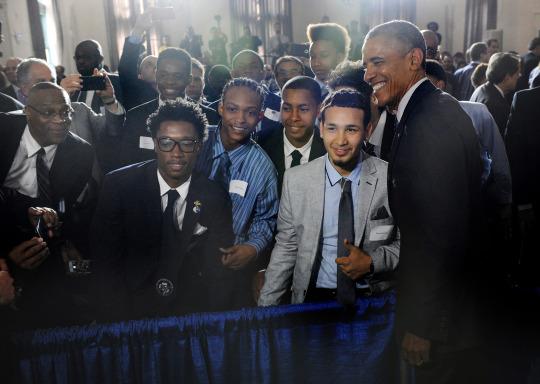
Students with President Obama at the launch of My Brother's Keeper alliance at Lehman College in the Bronx, N.Y., in May. (Susan Watts/The Daily News via AP, Pool)
If you can't appeal to their hearts, appeal to their pocketbooks.
That's what the president and his administration are doing to sell his My Brother's Keeper initiative, which seeks to help minority boys and young men succeed at school and in the workforce.
In May, the president said the business and nonprofit leaders who support My Brother's Keeper are "not doing this out of charity" or to assuage societal guilt.
"They're doing this because they know that making sure all of our young people have the opportunity to succeed is an economic imperative," Obama said.
Now the White House has released a report highlighting the potential economic gains the country would sustain if persistent educational gaps between boys of color and white boys were closed, one of the key goals of My Brother's Keeper. Minority men would earn $170 billion more each year, the total U.S. gross domestic product would spike by 1.8 percent and all American workers would see a 3.6 percent raise, the White House predicts. The more productive workers on the job, the more the economy will grow, the report argues, and investing in education for minority boys would be a fast way to get there.
The alternative is to allow more and more young men of color to continue to drop out of the labor force, adding to a long list of what the New York Times has called "Missing Black Men."
"For every [minority man] who was born 25 years ago, only half of them are employed today," said Betsey Stevenson, a member of the president's Council of Economic Advisers who helped write the report. "That means there are half of them we have lost — that's a lot of talent we are losing. When you think about it that way, it becomes obvious the toll it's taken on our nation."
The boys are lost to jail, early death and high unemployment, all societal problems My Brother's Keeper hopes to urge private businesses and local governments to tackle. Though the president's initiative has attracted hundreds of millions of dollars in pledges, the daunting goal of closing education and achievement gaps would take significantly more investment to solve.
The president started My Brother's Keeper last year, in part prompted by the death of teen Trayvon Martin, who was shot by a neighborhood watchman in an Orlando suburb. Obama was unusually vocal about Martin's death, arguing that stereotypes about minority boys and men being dangerous make them more likely to face violence themselves. "Trayvon Martin could have been me 35 years ago," Obama told the press two years ago, recalling how he would hear car doors locking as he walked down the streets. "We need to spend some time in thinking about how do we bolster and reinforce our African-American boys."
The president will make the goals of My Brother's Keeper a major part of his post-presidency. ("This will remain a mission for me and for Michelle not just for the rest of my presidency but for the rest of my life," he said in May.) Private-sector leaders have formed an independent nonprofit, called the MBK Alliance, that will continue the work long after Obama leaves office.
The initiative comes at a time when police shootings of young black men have roiled race relations across the country and reignited a debate about how the criminal justice system treats people of color. Activists have started a movement that asserts "Black lives matter" — and have pressured presidential candidates to weigh in on the issue. Meanwhile, a recent poll found that most Americans believe race relations in the country are bad — a steep increase from 2009, right after Obama took office.
Broderick Johnson, cabinet secretary and chair of the My Brother's Keeper Task Force, says the White House has been pleased by how the initiative has drawn bipartisan support. Cities run by white Republican mayors, such as Indianapolis, have embraced the call and pledged to help young minority men succeed.
"My Brother's Keeper was not designed to be a panacea on race relations by any means, but there's no question that it's having an impact on getting people across the country to see the importance of investing in boys and young men of color, whether for economic reasons or moral considerations," Johnson said. "What the president is very clear about in the wake of Trayvon Martin and other things that have happened in communities across the country is that we can't leave folks behind in this society and we have to invest in them."
My Brother's Keeper urges the hundreds of communities that have signed on to the program to make specific action plans. It recommends mentorship programs, expanding access to preschool, which shows lifelong benefits in later employment, and also reducing the use of suspensions and expulsions in kindergarten and elementary school, which are disproportionately doled out to boys of color.
The program has come under fire for its focus on men to the exclusion of women. More than 1,000 women of color, including civil rights leader Anita Hill, signed a letter last year urging the president to include girls in the program. "We simply cannot agree that the effects of these conditions on women and girls should pale to the point of invisibility, and are of such little significance that they warrant zero attention in the messaging, research and resourcing of this unprecedented Initiative," the women wrote.
"We don't leave them out — I think that stems from a bit of a misunderstanding," Johnson said of girls and young women. He said that helping boys and young men of color helps girls too, because they face many of the same disparities.
"Nevertheless, the emphasis on boys and young men of color is quite deliberate because that's where I think the most startling and glaring gaps are," he added.
###
"Hate Cannot Drive Out Hate. Only Love Can Do That", Dr. Martin Luther King.
__._,_.___
Posted by: Nzinink <nzinink@yahoo.com>
| Reply via web post | • | Reply to sender | • | Reply to group | • | Start a New Topic | • | Messages in this topic (1) |
----------------------------------------------------------------------------------------------------------
The hate of men will pass, and dictators die, and the power they took from the people will return to the people. And so long as men die, liberty will never perish.
I have loved justice and hated iniquity: therefore I die in exile.
The price good men pay for indifference to public affairs is to be ruled by evil men.
When the white man came we had the land and they had the bibles; now they have the land and we have the bibles.
----------------------------------------------------------------------------------------------------------
The Voice of the Poor, the Weak and Powerless.
-----------------------------------------------------------
Post message: AfricaRealities@yahoogroups.com
Subscribe: AfricaRealities-subscribe@yahoogroups.com
Unsubscribe: AfricaRealities-unsubscribe@yahoogroups.com
List owner: AfricaRealities-owner@yahoogroups.com
__________________________________________________________________
Please consider the environment before printing this email or any attachments.
---------------------------------------------------------------------------------------------------------------------
-http://www.africarealities.com/
-https://www.facebook.com/africarealities
-----------------------------------------------------------------------------------------
-New International Scholarships opportunities: http://www.scholarshipsgate.com
-----------------------------------------------------------------------------------------------
Find Friends in Africa:
http://www.africanaffection.com
http://www.datinginafrica.com/
http://www.foraha.net
https://www.facebook.com/onlinedatinginafrica
The hate of men will pass, and dictators die, and the power they took from the people will return to the people. And so long as men die, liberty will never perish.
I have loved justice and hated iniquity: therefore I die in exile.
The price good men pay for indifference to public affairs is to be ruled by evil men.
When the white man came we had the land and they had the bibles; now they have the land and we have the bibles.
----------------------------------------------------------------------------------------------------------
The Voice of the Poor, the Weak and Powerless.
-----------------------------------------------------------
Post message: AfricaRealities@yahoogroups.com
Subscribe: AfricaRealities-subscribe@yahoogroups.com
Unsubscribe: AfricaRealities-unsubscribe@yahoogroups.com
List owner: AfricaRealities-owner@yahoogroups.com
__________________________________________________________________
Please consider the environment before printing this email or any attachments.
---------------------------------------------------------------------------------------------------------------------
-http://www.africarealities.com/
-https://www.facebook.com/africarealities
-----------------------------------------------------------------------------------------
-New International Scholarships opportunities: http://www.scholarshipsgate.com
-----------------------------------------------------------------------------------------------
Find Friends in Africa:
http://www.africanaffection.com
http://www.datinginafrica.com/
http://www.foraha.net
https://www.facebook.com/onlinedatinginafrica

.


__,_._,___
Comments
Post a Comment